Abigail Fallis

b. 1969

In October 2008, sculptor Abigail Fallis became Pangolin London’s first sculptor in residence. During the year long residency Fallis used the fully-equipped studio facilities at Kings Place to focus on developing her practice. She also took time to contribute to the Kings Place outreach programme working with community groups and local schools on projects that explored both art and music.

The residency culminated in a solo exhibition titled Fallis in Wonderland which took place at Pangolin London in 2010 and recently toured to Newcastle. Talking about the exhibition, writer Tom Hodgkinson said that it was: “an exhibition of sculptures that are startling in their collision of qualities: for here is wit, beauty and protest; here is life and passion; here is playfulness and fun; here also is awe and wonder; and here is a commentary on an unsustainable way of living…Abigail Fallis’ work takes the fun, the wit and the radical political edge of Dada and combines it with beauty and gentleness and the result is a triumph.”

With guidance received from the foundry during her residency Abigail’s work has recently found a new technical bravado that sees her working to the highest level of crafsmanship in a wide range of media including bronze, silver, plaster, textiles and papier-mâché.

One of Fallis’ largest sculptures DNA DL90 has recently been installed in Newcastle where it was officially opened by celebrated scientist and nobel prize-winner Dr James Watson and Dr Matt Ridley, celebrated author of Genome and Red Queen.

Inspired by the structure of DNA, the sculpture was first commissioned by Somerfield to represent their support of the Muscular Dystrophy charity and focus public attention on their work to fund scientific research in possible treatments and cures. Further inspired by the 50th anniversary of Watson & Crick’s discovery of DNA’s double-helix structure which has been fundamental to the understanding of muscular dystrophy itself, Fallis found that by illustrating science with an icon of consumerist culture, a number of interesting and topical dialogues arose. Fallis says: “shopping trolleys are everywhere, and have become a real symbol of modern society and today’s consumer culture. So much so that one could say that consumerism is inextricably linked to our genetic makeup”.

DNA DL90 also alludes to scientific investigations into the designer baby, and the lengths that society is prepared to go to ensure a perfect specimen as well as touching on the suggestion that consumerism has outstripped religion.

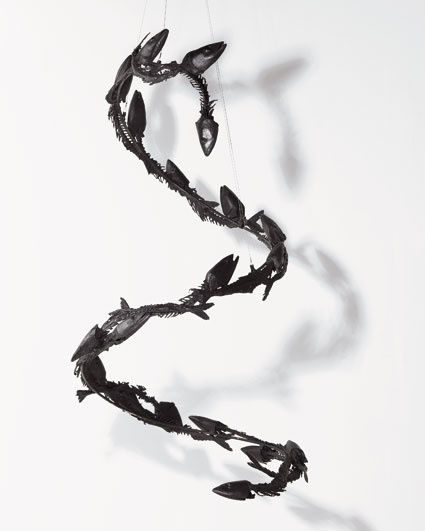
Having studied silversmithing and metalwork at Camberwell College of Arts, Fallis’ work often uses recycled materials, ranging from babies dummies to fish skeletons, to comment on the blight of consumerism in today’s society. Preferring to use witty humour to communicate her message rather than shock tactics Fallis believes the topical issues that interest her are much more effectively communicated when they avoid playing directly on human guilt. DNA DL90’s new location near Newcastle’s world-class Centre for Life is particularly fitting and Fallis hopes the sculpture will continue to challenge our concepts of the relationship between consumerism and genetics.

Abigail Fallis
Abigail Fallis